
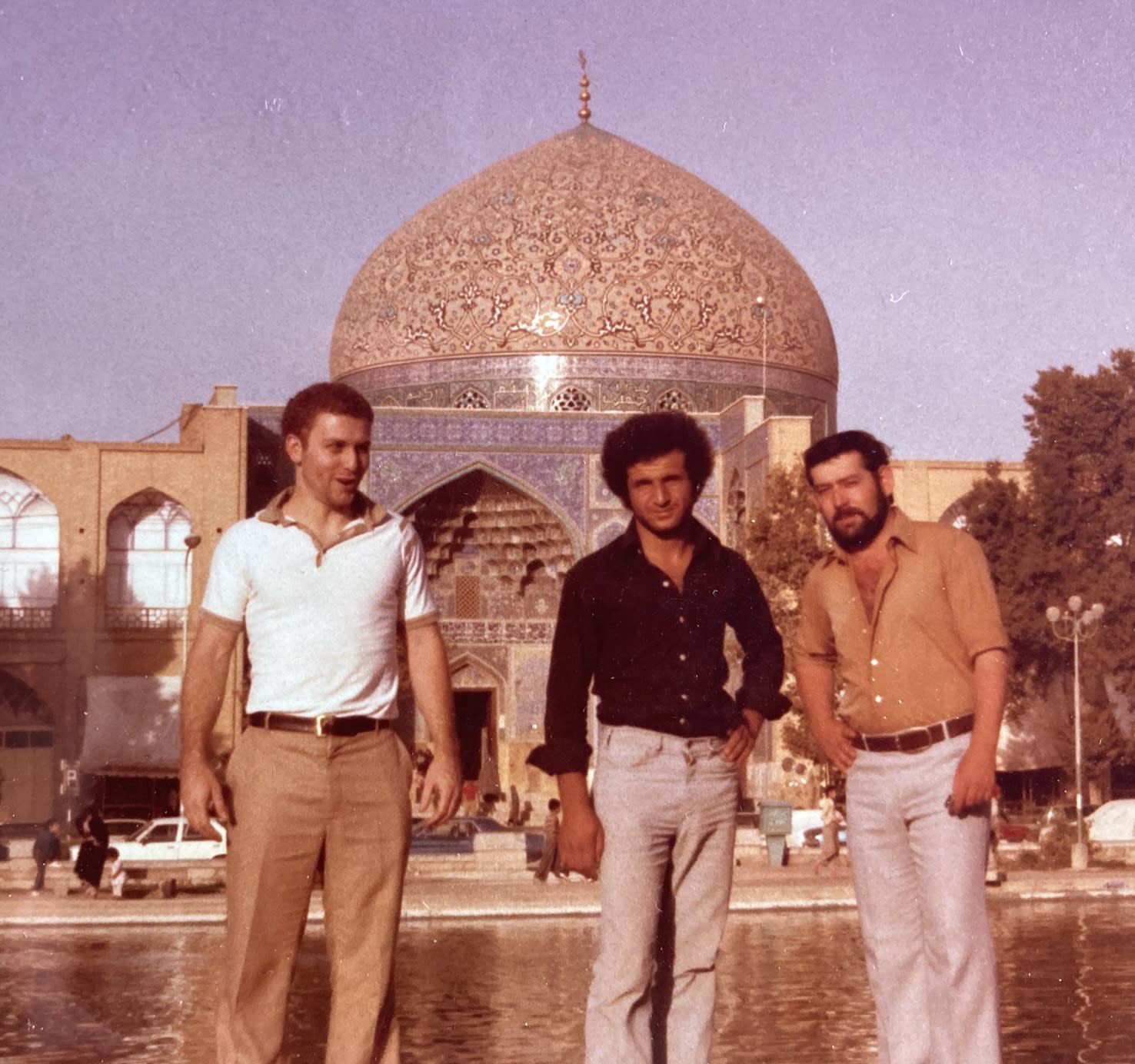
Steve Dewey (left) with Iranian drive and British co-worker, Shah Square, Isfahan, Iran, August 1978. (Photo credit Steve Dewey).
I was in Iran from July to December 1978 as a project accountant at a joint Iranian-American military-industrial project outside of Isfahan, Iran. It was during that time that I witnessed the final months of the totalitarian regime of the Shah of Iran, Mohammad Reza Pahlavi. At the time, the project had an estimated completion value of about $350 million, which equates to about $1.73 billion in current 2026 US Dollars. I was one of about 120 expatriates working on the project – mostly American with some Brits – and an Iranian labor force of over 1,000.
Not long after I arrived at the project site, about 20 miles north of Isfahan, I started hearing about civil unrest in Tehran and other parts of the country. Initially, these reports were dismissed by our American management team as nothing to worry about, but as the weeks went by, the reports became more frequent and appeared to indicate more widespread protests around the country with increasing violence and the use of the Iranian military.
The civil unrest became so bad that it eventually caused the end of the project. At some point in the latter months of 1978, the Iranian government ceased making contract payments to the contractors on the project. Thus, all of the American companies engaged on the project decided to terminate their contracts with the Iranian government, evacuate the project, and fly everyone home. I departed in early December 1978. The Shah was overthrown just two months later on February 11, 1979 – a date that has since been honored as an official national holiday celebrating the Islamic Revolution.
Before leaving the project, I asked some of the English-speaking Iranians that I had become friendly with about the civil unrest that had erupted around the country. Without exception, they blamed it on the Shah and expressed their hatred of the Shah. They described the Shah as enormously corrupt and a megalomaniac who kept most of the country’s oil revenue – about $20-$25 billion per year at the time – under his complete control to use only as he saw fit, which meant he kept most of the nation’s wealth for himself, his family and friends, and his pet projects to enhance his own image both at home and abroad. One of my Iranian co-workers I spoke with, who was educated in the United States and spoke fluent English, told me the hatred of the Shah was so deep that he believed up to 90 percent of the country opposed him.
The Iranian people also despised the Shah because of his secret security force, Savak, which was known within Iran for its brutality, including the torture and killing of the Shah’s political opponents over many years. It was reported that the Shah personally ordered Savak to imprison and execute nine prominent political opponents in 1975. During the Shah’s last year in power, it was estimated that Savak and the Iranian Army under the Shah killed over 50,000 Iranian protesters during various anti-Shah street protests. In fact, during my last night in Iran, while staying in a company-selected hotel in Tehran, I heard machine gun fire throughout the night from a distance that sounded to be a few miles away. On my taxi ride to the airport the next morning to fly home, the tax driver told me that the machine gun fire I heard was a gun battle between anti-Shah revolutionaries and the Shah’s military forces.
American Misinformation/Misunderstanding about Iran’s Regime History
Anyone who listens to American politicians in Washington, foreign policy/national security think tank gurus, or any number of talking heads in the American news media on a regular basis will be convinced that the Islamic Republic of Iran is pure evil and should be destroyed. However, a look at some objective, non-politicized facts involving Iran’s regime history and its current domestic support reveals a dramatically different picture.
As discussed above, it is evident from the Islamic Revolution that the vast majority of the Iranian people opposed the Shah’s regime. The Shah was overthrown because his own people rose up against him organically, without any foreign involvement, and forced him to flee the country. This fact is ignored by the American media and twisted to portray the Shah as great leader of Iran and friend of the United States who should have been saved with American intervention.
Yet another reason for the Iranian people’s disdain for the Shah was their long-held view of him as a puppet of the United States. This dates back to 1953 when America’s CIA and Britain’s MI6 intelligence services executed a regime change in Iran (CIA code name “Operation Ajax”) by ousting a popular prime minister, Mohammad Mossadegh, who had achieved overwhelming domestic support for his nationalist agenda. This was a concern for the United States, Britain, and the West, because Mossadegh was the first prime minister elected by the Iranian parliament without an endorsement by the pro-Western Shah who had acted as the de facto head of the government since 1941 (contrary to the constitutional monarchy established in 1906 that established the prime minister as the head of government). The Shah disliked Mossadegh, because he was a populist threat to the Shah’s authoritarian rule over the previous decade.
In addition to the West’s apprehension over losing a reliable pro-Western head of state in Iran, there was also major alarm over Mossadegh’s nationalization of Iran’s oil industry. The Anglo-Iranian Oil Company (AIOC), a British-controlled entity (later renamed British Petroleum or BP), had held the exclusive concession for oil exploration and production in Iran since 1901 and controlled almost all of its revenue. When the Iranian government officially nationalized AIOC in May 1951, it was operating the largest oil refinery in the world, the Abadan refinery, producing about 7 percent of the world’s total crude oil.
Mossadegh’s historic nationalization agenda and the prospect of losing a pro-Western Iranian government under the Shah motivated the United States and Britain to plan and execute its joint covert operation to oust Mossadegh as prime minister and restore the Shah as the supreme leader of the country. The restoration of the Shah’s position as the authoritarian head of government was further enhanced with financial and military support from the West, particularly the United States. This was accompanied by the Shah’s ending of Mossadegh’s nationalization of Iran’s oil industry and opening it to Western companies.
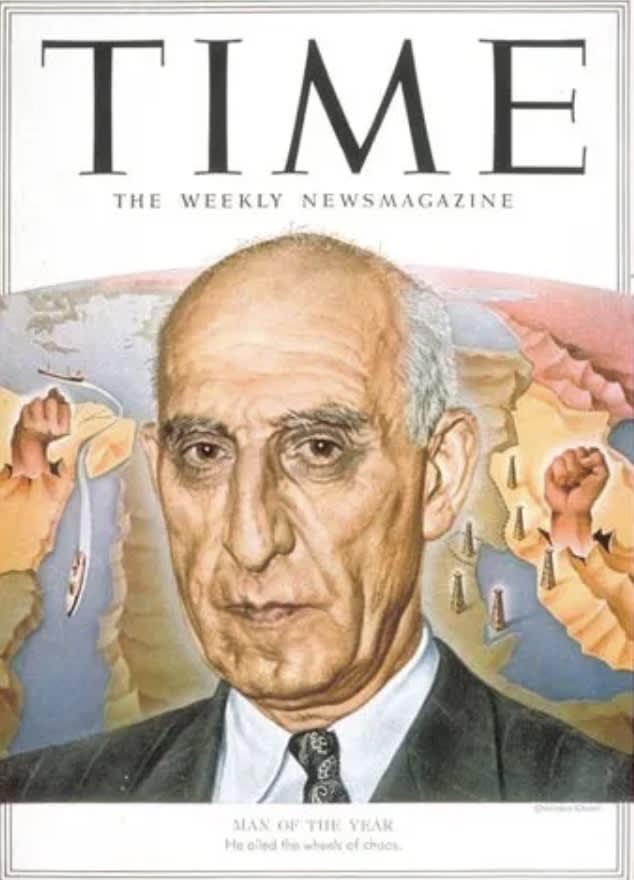
Mohammad Mossadegh, Prime Minister of Iran, 1951-1953, Time magazine Man of the Year, 1951(image credit: content.time.com)
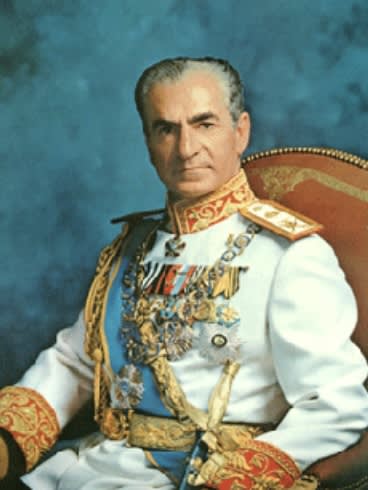
Mohammad Reza Pahlavi, Shah (king/monarch) of Iran, 1941-1979 (image credit: wikipedia/pahlavi.org)
The regime change executed by the CIA and MI6 in 1953 had profound negative consequences on U.S.-Iran relations. CIA documents declassified in 2013 confirm details of the regime change operation (Operation Ajax) and supports the case that it caused long-term resentment by the Iranian people towards that United States and was a contributing factor in the 1979 Islamic Revolution that ousted the Shah.
Iranian resentment towards American support for the Shah took a dramatic turn for the worse when President Jimmy Carter allowed the Shah to enter the United States on October 22, 1979 to receive medical treatment for cancer. This triggered Iranian students to seize the U.S. embassy in Tehran on November 4, 1979 and proceed to hold over 50 American embassy staff hostage for 444 days until that January 20, 1981, the date of Ronald Reagan’s first presidential inauguration. The seizing of the U.S. embassy and its American staff resulted in the United States terminating diplomatic relations with Iran on April 7, 1980. Relations between the two countries have been cold and distrustful since then with only limited, special purpose diplomatic interaction.
CIA/MI6 “Operation Ajax” a Monumental Mistake
When the CIA and MI6 conceived Operation Ajax to overthrow Prime Minister Mossadegh and restore the Shah to power in 1953, they believed it was in the best national interests of the United States and Britan. But as many of the 80-plus CIA regime change operations have proven since the CIA was created in 1947, most do not work out as planned and only result in worse outcomes. This was certainly the case with Operation Ajax. Not only did it remove a very popular prime minister with overwhelming support in the Iranian parliament and replace him with an unpopular dictatort, it also destroyed the long-term potential for a fruitful, mutually beneficial relationship with the United States and other Western countries.
Because of the U.S. embassy hostage crisis in Tehran from November 1979 to January 1981 and the termination of diplomatic relations in April 1980, American politicians and the Western media have generally stayed away from any mention of Operation Ajax and have followed the institutionalized narrative of Iran as an evil regime and an enemy of the West. However, former German chancellor Olaf Scholz made unusually candid comments about Iran in an interview on February 9th this year. He stated that the root of the international dilemma with Iran today stems from the American and British overthrow of a democratically elected government in 1953 and replaced with a brutal dictator, the Shah. He said that without this coup, Iran would be a very great Western country today.
Chancellor Scholz’ comments that Iran could have become a great Western country are not unreasonable, because Prime Minister Mossadegh was not anti-American or anti-West despite his nationalization agenda. To the contrary, Mossadegh simply favored an “Iran First” policy agenda, an independent, non-aligned foreign policy, and a willingness for good relations with all nations. Thus, the CIA/MI6 overthrow of Mossadegh in 1953 was ill-conceived and has proven to be a monumental mistake with adverse consequences lasting to this day.
Trump Must Revert to His Peace Instincts on Iran, Reject Neocon Push for War
The deployment of a massive array of U.S. naval and air power to the Middle East for a potential attack on Iran makes no sense from an American national interest perspective. An attack would carry with it enormous risks, including military, economic, humanitarian, and geopolitical. In a worst-case scenario, it could risk escalating into a much broader and deadlier war involving multiple surrounding countries and even China and Russia.
It was reported in multiple media outlets on February 23rd that General Dan Caine, Chairman of the Joint Chiefs of Staff, has expressed concerns about the potential risks of a military campaign against Iran. According to a report in The Wall Street Journal, the risks identified by General Caine include an over-extended and exhausted U.S. military (especially U.S. Navy personnel who have been at sea for excessively long periods of time), potentially high American and allied casualties, depleted air defenses and depleted munitions, and high financial costs with an extended campaign (adding to an ever-growing national debt).
There are additional risks not discussed in the articles that are important to note. First, Iran has a very powerful ballistic missile force and a plentiful drone inventory to launch against U.S. targets. Iran’s ballistic missile force is estimated at approximately 2,000 missiles, including perhaps 100 to 200 hypersonic missiles that cannot be intercepted with anti-missile defense systems. Iran is also estimated to have a current inventory of around 80,000 drones. Second, Iran has the benefit of Chinese and Russian intelligence support, including the integration of China’s most advanced satellite and surveillance systems. Third, Iran could easily disrupt the flow of oil out of the Persian Gulf, which would be increasingly devastating to the global economy the longer a shut down would last (25 to 30-percent of the world’s oil production flows out of the Persian Gulf). For these reasons, Iran could prove to be a very challenging and costly opponent in a U.S. military attack.
As for the current negotiations with Iran, President Trump and his team should understand that the Iranians are not going to capitulate under the threat of a U.S. attack. A reasonable negotiated agreement with Iran is already at hand as the Iranians have consistently agreed not to develop nuclear weapons and have consistently agreed to allow international weapons inspectors into its country to investigate any potential nuclear weapons program. From the Iranian point of view, to concede anything more is an unacceptable surrender of its national sovereignty.
Iran is also an officially recognized participant in the Non-Proliferation Treaty. This is in sharp contrast to Israel who is one of only four countries in the world — and the only country in the Middle East — who is not a participant in the Non-Proliferation Treaty despite allegedly possessing up to 90 nuclear warheads. Thus, President Trump should accept the very reasonable deal that is already achievable with Iran and avoid a completely unnecessary and potentially very costly war.
The Folly of Promoting the Shah’s Son as Iran’s New Leader
Finally, one of the most absurd and misguided narratives I’ve seen in the American media over the past year has been the shameful promotion of the Shah’s son, Reza Pahlavi, to be Iran’s new leader. Mr. Pahlavi has not even been in Iran since he left in July 1978 at the age of 18. He’s been living in the Washington, DC metro area since the mid-1980s . The TV networks who have been featuring Pahlavi in fawning interviews, improperly referring to him as “His Highness,” are shockingly ignorant about the massively corrupt and despotic nature of his father’s regime and the hatred the Iranian people have had of him over a period of many decades.
Former CIA official John Kiriakou, an expert on the Middle East, made the following sharp comment about the prospect of Mr. Pahlavi returning to Iran on his YouTube podcast on January 12th this year: “He (Mr. Pahlavi) wouldn’t survive the walk from the plane to the terminal if he were to fly back to Iran.”
To President Trump’s credit, he has expressed strong reservations about the viability of Mr. Pahlavi as a prospective new leader of Iran and has avoided any meetings with him thus far.


