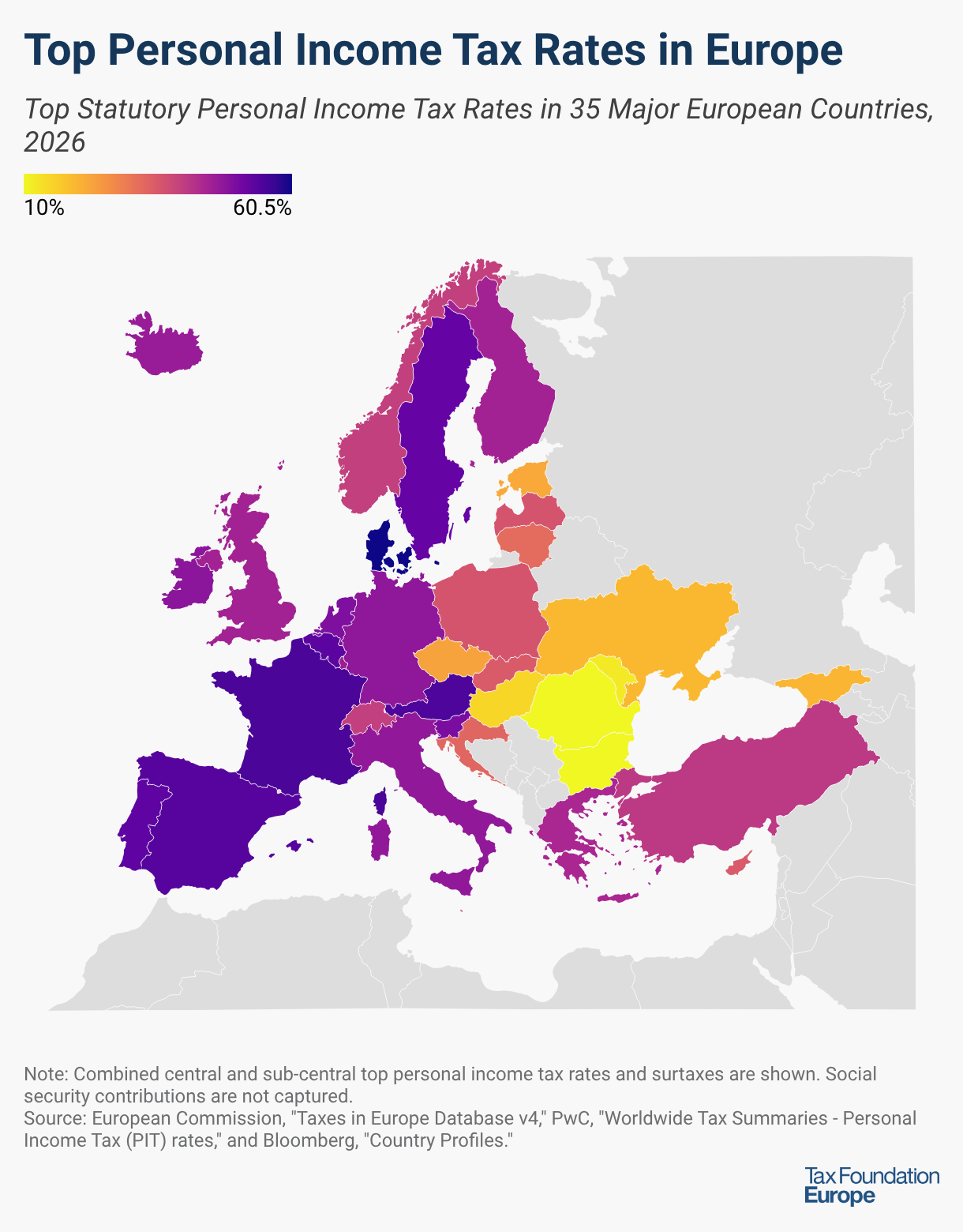
Top Personal Income Tax Rates in Europe, 2026
By: Alex Mengden
Most countries’ personal income taxes have a progressive structure, meaning that the tax rate paid by individuals increases as they earn higher wages. The highest tax rate individuals pay differs significantly across European countries.
The top statutory personal income tax rate applies to the share of income that falls into the highest tax bracket. For instance, if a country has five tax brackets, and the top income tax rate of 50 percent has a threshold of €1 million, each additional euro of income over €1 million would be taxed at 50 percent.
Governments can generally generate revenue more efficiently by leveraging marginal tax rates at the lower end of the income distribution than by using higher top rates. This is because applying a higher rate to a tax bracket negatively affects the incentive to earn more or less income only for individuals in that bracket, while also raising revenue from all taxpayers in higher brackets. In contrast, high top rates negatively affect the earning incentives of all individuals from whom they raise revenue.
Top Personal Income Tax Rates in Europe
Note: Combined central and sub-central top personal income tax rates and surtaxes are shown. Social security contributions are not captured.
Source: European Commission, “Taxes in Europe Database v4,” PwC, “Worldwide Tax Summaries – Personal Income Tax (PIT) rates,” and Bloomberg, “Country Profiles.”
Top Statutory Personal Income Tax Rates in 35 Major European Countries, 2026
|
Country
|
Top Statutory Personal Income Tax Rate
|
|---|---|
| Austria (AT) | 55.0% |
| Belgium (BE) | 53.5% |
| Bulgaria (BG) | 10.0% |
| Croatia (HR) | 33.0% |
| Cyprus (CY) | 35.0% |
| Czech Republic (CZ) | 23.0% |
| Denmark (DK) | 60.5% |
| Estonia (EE) | 22.0% |
| Finland (FI) | 45.0% |
| France (FR) | 55.4% |
| Georgia (GE) | 20.0% |
| Germany (DE) | 47.5% |
| Greece (GR) | 44.0% |
| Hungary (HU) | 15.0% |
| Iceland (IS) | 46.3% |
| Ireland (IE) | 48.0% |
| Italy (IT) | 47.2% |
| Latvia (LV) | 36.0% |
| Lithuania (LT) | 32.0% |
| Luxembourg (LU) | 45.8% |
| Malta (MT) | 35.0% |
| Moldova (MD) | 12.0% |
| Netherlands (NL) | 49.5% |
| Norway (NO) | 39.6% |
| Poland (PL) | 36.0% |
| Portugal (PT) | 53.0% |
| Romania (RO) | 10.0% |
| Slovak Republic (SK) | 35.0% |
| Slovenia (SI) | 50.0% |
| Spain (ES) | 54.0% |
| Sweden (SE) | 52.3% |
| Switzerland (CH) | 39.7% |
| Turkey (TR) | 40.8% |
| Ukraine (UA) | 19.5% |
| United Kingdom (GB) | 45.0% |
Note: Combined central and sub-central top personal income tax rates and surtaxes are shown. Social security contributions are not captured.
Source: European Commission, “Taxes in Europe Database v4,” PwC, “Worldwide Tax Summaries – Personal Income Tax (PIT) rates,” and Bloomberg, “Country Profiles.”